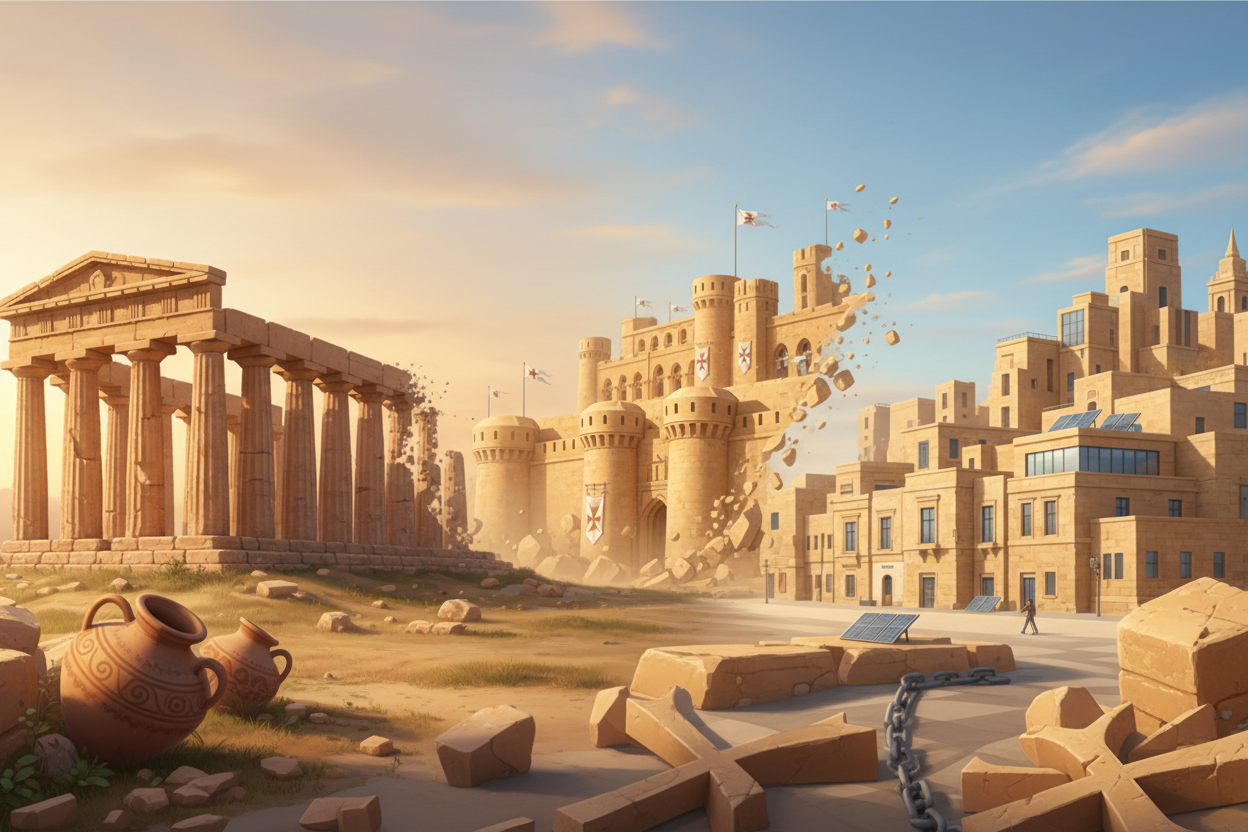
Nestled in the heart of the Mediterranean Sea, Malta stands as a living testament to over 7,000 years of human civilization. This small archipelago, consisting of Malta, Gozo, and Comino, has witnessed the rise and fall of empires, the clash of cultures, and the evolution of societies that have shaped its unique identity. From prehistoric temple builders to modern European Union membership, Malta’s historical journey reads like an epic novel filled with drama, conquest, resilience, and triumph.
The Maltese Islands have served as a crucial crossroads between Europe, Africa, and Asia, making them a coveted prize for successive civilizations. Each era has left its indelible mark on the islands’ landscape, architecture, culture, and people. Today, visitors can walk through millennia of history simply by strolling through Malta’s ancient streets, where Neolithic temples stand alongside baroque churches and medieval fortifications.
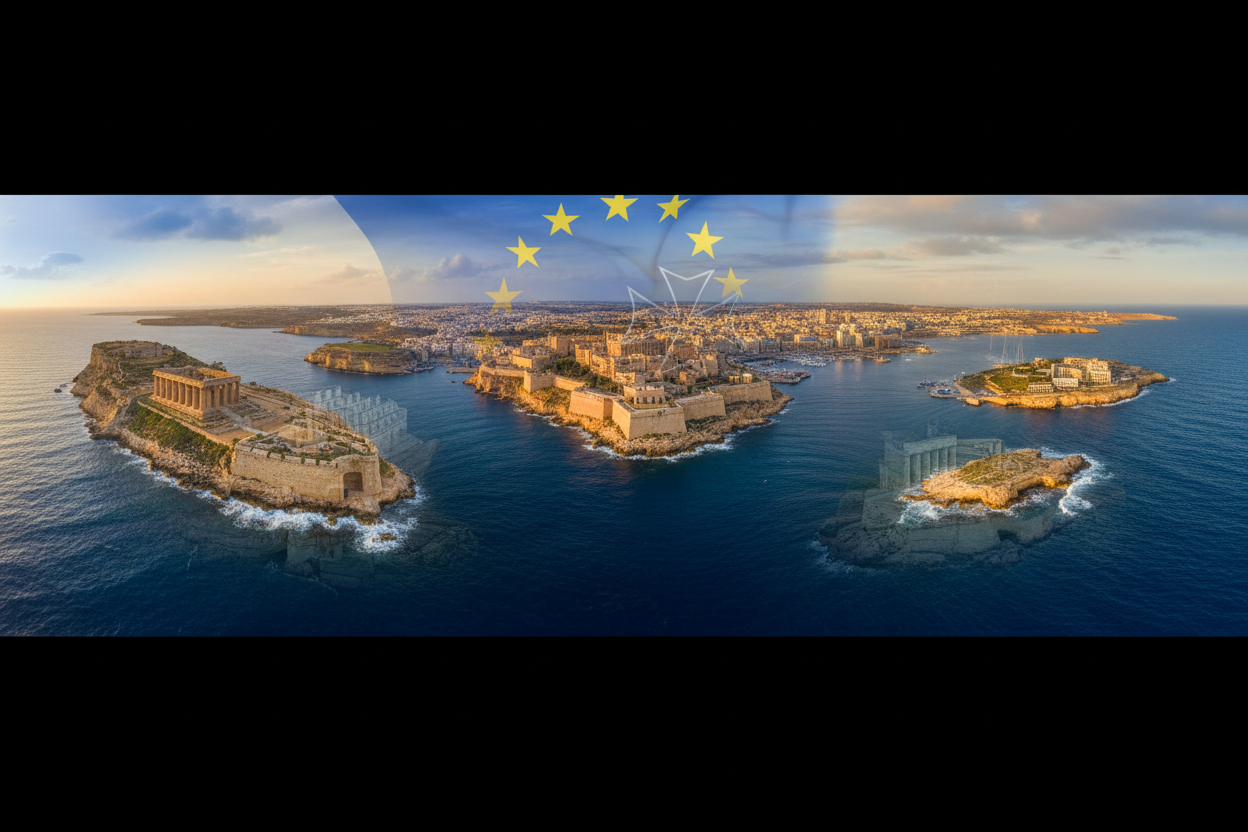
Prehistoric Malta: The Temple Builders (5900-2500 BCE)
Malta’s recorded history begins with some of humanity’s most remarkable achievements in prehistoric architecture. The first inhabitants arrived around 5900 BCE, likely from Sicily, bringing with them agricultural knowledge and the skills to create what would become the world’s oldest free-standing stone structures.
The Temple Period, spanning from approximately 3600 to 2500 BCE, represents one of the most extraordinary chapters in Malta’s ancient history. During this time, the island’s inhabitants constructed over 30 megalithic temples, with seven of them now recognized as UNESCO World Heritage Sites. These include the famous Hagar Qim, Mnajdra, and the Tarxien Temples on Malta, as well as the Ggantija Temples on Gozo.
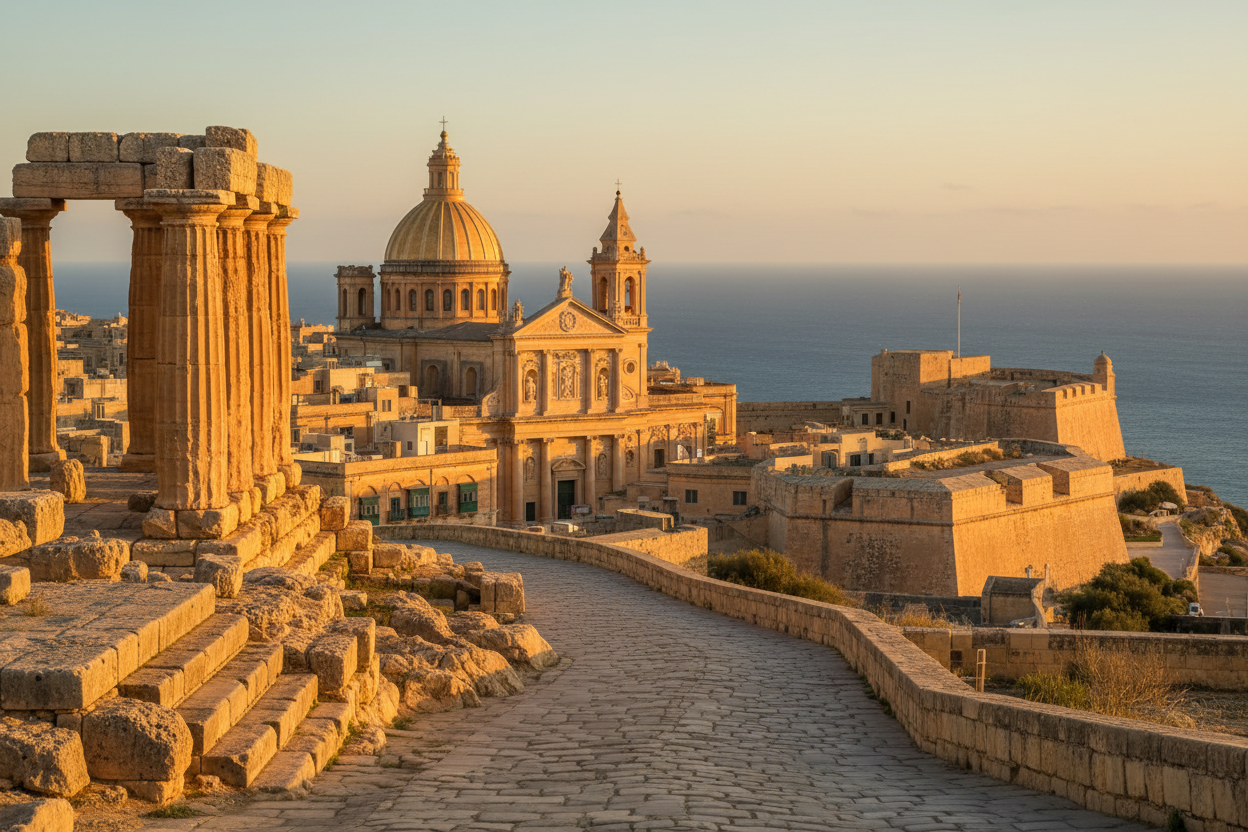
What makes these temples truly remarkable is their sophistication and age. The Ggantija Temples, for instance, predate Stonehenge by over 1,000 years and the Egyptian pyramids by 500 years. The builders demonstrated advanced knowledge of astronomy, engineering, and artistry, creating structures aligned with celestial events and decorated with intricate spiral carvings and animal reliefs.
Archaeological evidence suggests these temple builders developed a complex society with specialized craftspeople, artists, and possibly a priestly class. The mysterious disappearance of this temple-building civilization around 2500 BCE remains one of archaeology’s great puzzles, leaving behind only their magnificent stone monuments and tantalizing clues about their sophisticated culture.
Bronze Age and Phoenician Influence (2500-218 BCE)
Following the mysterious disappearance of the temple builders, Malta entered the Bronze Age around 2500 BCE. New settlers arrived, bringing different cultural practices and technologies. While less is known about this period, archaeological evidence suggests continued habitation and the gradual development of new settlements.
The Phoenicians, master traders of the ancient Mediterranean, recognized Malta’s strategic importance around 750 BCE. They established the islands as a crucial stop along their extensive trade networks, connecting the eastern and western Mediterranean. The Phoenicians introduced their alphabet, advanced maritime technology, and commercial practices that would influence Malta for centuries.
Under Phoenician influence, Malta developed into a thriving trading hub. The natural harbors provided safe anchorage for merchant vessels, while the islands’ central location made them an ideal waystation for traders carrying goods between North Africa, Europe, and the Levant. This period laid the foundation for Malta’s enduring role as a maritime crossroads.
Roman Rule: Integration into the Empire (218 BCE-870 CE)
Malta’s integration into the Roman Empire in 218 BCE marked the beginning of over a millennium of Roman influence. The Romans, recognizing the islands’ strategic value, developed Malta into an important naval base and trading center. They constructed roads, aqueducts, and public buildings, many remnants of which can still be seen today.
One of the most significant events during Roman rule occurred in 60 CE when the Apostle Paul was shipwrecked on Malta’s shores. According to the Acts of the Apostles, Paul spent three months on the island, performing miracles and converting the population to Christianity. This event profoundly shaped Malta’s religious identity, making it one of the earliest Christian communities in the Mediterranean.
The Roman period brought prosperity and cultural development to Malta. Latin became the administrative language, Roman law was implemented, and the islands were fully integrated into the empire’s economic system. Archaeological sites like the Roman Villa in Rabat and the Roman Baths in Ghajn Tuffieha provide glimpses into the sophisticated lifestyle enjoyed by Malta’s Roman inhabitants.
As the Western Roman Empire declined, Malta remained under Byzantine control from 395 CE, maintaining its Christian identity and Roman legal traditions even as political power shifted eastward to Constantinople.
Arab Period: Cultural Transformation (870-1091)
The Arab conquest of Malta in 870 CE initiated a period of profound cultural transformation that would permanently alter the islands’ character. Under Arab rule, Malta experienced significant changes in language, agriculture, architecture, and social organization.
The Arabs introduced new agricultural techniques, including advanced irrigation systems that made previously barren areas productive. They brought citrus fruits, cotton, and new varieties of vegetables, diversifying Malta’s agricultural output. The terraced fields that characterize much of Malta’s landscape today trace their origins to this period.
Perhaps most significantly, the Arabs introduced the language that would evolve into modern Maltese. While Malta later returned to Christian rule, the Semitic linguistic foundation remained, making Maltese unique as the only Semitic language written in Latin script and recognized as an official language of the European Union.
Arab architectural influences can still be seen throughout Malta, particularly in the flat-roofed houses, narrow winding streets, and the use of local limestone in construction. The Arabs also established new settlements and improved the islands’ fortifications, recognizing Malta’s continued strategic importance in Mediterranean trade routes.
Norman and Medieval Period (1091-1530)
The Norman conquest of Malta in 1091, led by Count Roger I of Sicily, marked the islands’ return to Christian rule and integration into the emerging medieval European political system. Under Norman and subsequent Sicilian rule, Malta experienced a gradual re-Christianization while retaining many beneficial aspects of Arab culture.
The medieval period saw the construction of numerous churches and the establishment of feudal systems of governance. The population, which had adopted Islam under Arab rule, gradually converted back to Christianity, though this process took several centuries and was generally peaceful.
During this time, Malta’s strategic importance continued to grow. The islands served as a crucial link in Mediterranean trade networks, and their harbors provided shelter for merchant vessels and naval fleets. The medieval period also saw the development of Malta’s distinctive architectural style, blending Norman, Arab, and local influences.
The construction of Mdina, Malta’s ancient capital, reached its zenith during this period. Known as the “Silent City,” Mdina showcased the architectural and cultural synthesis that characterized medieval Malta, with its narrow streets, noble palaces, and impressive fortifications creating a unique urban landscape that survives largely intact today.
Knights of St. John: The Golden Age (1530-1798)
The arrival of the Knights of St. John in 1530 ushered in what many consider Malta’s golden age. Granted the islands by Holy Roman Emperor Charles V, the Knights transformed Malta into a powerful fortress state and a bulwark of Christian Europe against Ottoman expansion.
The Great Siege of 1565 represents the most dramatic chapter of this period. When Suleiman the Magnificent’s Ottoman fleet arrived with over 40,000 troops to capture Malta, the Knights and Maltese defenders, numbering fewer than 9,000, faced seemingly impossible odds. The four-month siege became one of history’s most celebrated defensive victories, with the successful resistance halting Ottoman expansion into the western Mediterranean.
Following their victory, the Knights embarked on an ambitious building program that transformed Malta’s landscape. They constructed the magnificent city of Valletta, designed by the military engineer Francesco Laparelli, which became one of Europe’s finest examples of Renaissance urban planning. The city’s grid layout, impressive fortifications, and baroque architecture created a capital worthy of the Knights’ prestige.
Under the Knights’ rule, Malta became a center of learning, art, and culture. They established hospitals, libraries, and schools, while attracting artists, architects, and scholars from across Europe. The Co-Cathedral of St. John in Valletta, with its ornate baroque interior and Caravaggio masterpieces, exemplifies the cultural achievements of this period.
The Knights also developed Malta’s economy, improving agriculture, establishing new industries, and maintaining the islands as a crucial Mediterranean trading hub. Their naval activities, including campaigns against Ottoman and Barbary corsairs, brought wealth and prestige to Malta while protecting Christian shipping throughout the Mediterranean.
French Occupation and British Colonial Era (1798-1964)
Napoleon’s conquest of Malta in 1798 ended 268 years of Knights’ rule and initiated a brief but tumultuous period of French occupation. The French quickly alienated the Maltese population through their anti-religious policies, heavy taxation, and cultural insensitivity. Within months, a popular uprising had begun, supported by the British Royal Navy.
The Maltese rebellion against French rule demonstrated the population’s strong Catholic identity and desire for self-determination. After a two-year blockade, the French garrison surrendered in 1800, and Malta came under British protection. The Treaty of Amiens in 1802 briefly returned Malta to the Knights, but renewed warfare led to permanent British control, formalized in the Treaty of Paris in 1814.
British colonial rule transformed Malta into a crucial naval base and coaling station for the Royal Navy. The opening of the Suez Canal in 1869 further enhanced Malta’s strategic importance as a waystation between Britain and India. The British invested heavily in Malta’s infrastructure, constructing dockyards, fortifications, and public buildings while improving education and healthcare systems.
The colonial period brought significant social and economic changes. English became the language of administration and education alongside Italian and Maltese. New industries developed, including shipbuilding and repair, while tourism began to emerge as Malta’s natural beauty and historical sites attracted Victorian travelers.
World War II marked the most challenging period of British rule. Malta’s strategic position made it a primary target for Axis forces, and the islands endured one of the war’s most intensive bombing campaigns. The courage and resilience of the Maltese people during this period earned the entire population the George Cross, Britain’s highest civilian decoration, awarded by King George VI in 1942.
Independence and Modern Malta (1964-Present)
Malta’s journey to independence began in earnest after World War II, as nationalist sentiment grew and the British Empire began its gradual dissolution. The Malta Labour Party, led by Dom Mintoff, and the Nationalist Party engaged in complex negotiations with Britain throughout the 1950s and early 1960s.
On September 21, 1964, Malta achieved independence while remaining within the British Commonwealth. The new nation faced significant challenges, including economic dependence on the British military presence and the need to diversify its economy. The closure of British military facilities in 1979 forced Malta to reinvent itself economically.
Under various governments, Malta pursued different strategies for development. The country invested in manufacturing, tourism, and financial services while maintaining its strategic neutrality during the Cold War. Malta’s unique position allowed it to host important diplomatic meetings, including the 1989 Malta Summit between Presidents Bush and Gorbachev, which helped end the Cold War.
The 1990s brought significant political and economic reforms as Malta prepared for European Union membership. The country modernized its legal system, improved infrastructure, and developed new industries including information technology and online gaming. Malta’s accession to the EU in 2004 marked a new chapter in its history, providing access to European markets and development funds.
Today’s Malta successfully balances its rich historical heritage with modern development. The country has become a popular tourist destination, attracting millions of visitors annually who come to explore its prehistoric temples, medieval cities, and baroque architecture. Malta’s economy has diversified significantly, with thriving sectors in financial services, manufacturing, tourism, and digital technology.
The Maltese have preserved their unique cultural identity while embracing globalization. The Maltese language, with its Semitic roots and European vocabulary, remains a living link to the islands’ complex history. Traditional festivals, crafts, and customs continue alongside modern European lifestyles, creating a distinctive cultural blend that reflects Malta’s historical journey.
Conclusion
Malta’s historical timeline reveals a remarkable story of survival, adaptation, and cultural synthesis spanning over seven millennia. From the mysterious temple builders of prehistory to today’s modern European nation, Malta has consistently demonstrated an ability to absorb diverse influences while maintaining its unique identity.
The islands’ strategic location has been both a blessing and a challenge, attracting successive civilizations while requiring constant vigilance and adaptation. Each period of Malta’s history has contributed layers to its rich cultural tapestry, creating a nation that is simultaneously ancient and modern, European and Mediterranean, cosmopolitan and deeply rooted in tradition.
As Malta continues to evolve in the 21st century, facing new challenges from globalization, climate change, and technological advancement, its historical experience provides valuable lessons. The Maltese have repeatedly shown that small nations can thrive by embracing change while preserving their essential character, by welcoming diversity while maintaining unity, and by honoring the past while building for the future.
For visitors and students of history alike, Malta offers an unparalleled opportunity to walk through time, experiencing firsthand the layers of civilization that have shaped this remarkable archipelago. From ancient temples to modern cities, from medieval fortifications to contemporary art galleries, Malta’s historical timeline continues to unfold, adding new chapters to one of the Mediterranean’s most fascinating stories.
 English
Leave a Reply